
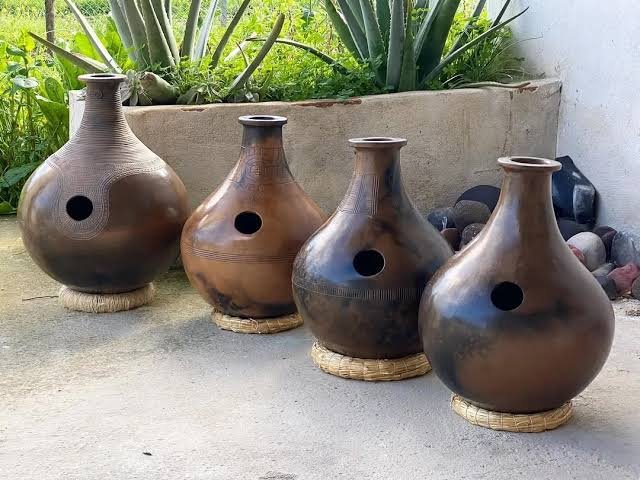
At first glance, the Udu looks like an ordinary clay pot. Its rounded body and hollow chamber reveal little about the role it has played in preserving one of Nigeria’s oldest musical traditions. Yet for generations, this simple vessel has carried far more than water. It has carried rhythm, ceremony and identity. The word Udu pronounced OO-doo—means “pot” or “vessel” in the Igbo language. Before it became a musical instrument, it was an everyday object found across many Igbo communities in southeastern Nigeria, used primarily for storing and fetching water. Like many of Africa’s greatest cultural innovations, its transformation into an instrument began within ordinary communities, where creativity often emerged from the familiar. According to oral tradition, the instrument’s musical qualities were discovered after a second opening was added to the clay vessel. When struck with the hands while controlling the flow of air through its openings, the pot produced a deep, resonant bass tone unlike the sound of conventional drums. What was once a household object gradually evolved into one of Africa’s most distinctive percussion instruments.
Its history is inseparable from the people who shaped it. Across many Igbo communities, pottery was traditionally a craft practiced by women, with techniques passed from one generation to another. From the same clay that produced cooking pots and water vessels emerged an instrument that would eventually accompany ceremonies, festivals and communal gatherings. Its presence can still be felt today. Across parts of Igboland and neighbouring communities in Delta State, traditional cultural ensembles continue to perform during burials, traditional weddings, festivals and important community celebrations. These performances often combine singers, dancers and instrumentalists dressed in coordinated traditional attire, creating a spectacle where music and movement become inseparable. Among the most recognisable of these performances is the energetic ‘Atilogwu dance’, celebrated for its athletic movements, synchronised choreography and vibrant display of Igbo culture.
Within these ensembles, every instrument has its own responsibility. Some carry melody. Others maintain rhythm. The Udu performs a quieter but equally essential role. Its deep, hollow resonance provides the bass foundation upon which the rest of the ensemble is built; it anchors the music, giving weight and balance to the faster rhythms surrounding it. The Udu has quietly found its way into contemporary Nigerian music, particularly in productions rooted in eastern Nigerian musical traditions. Producer, Masterkraft has consistently demonstrated how indigenous percussion can coexist with modern production, preserving the warmth and authenticity of traditional instrumentation within contemporary records. One of the clearest examples is “Egedege,” Larry Gaga’s collaboration with Phyno and legendary Egedege cultural icon Theresa Onuorah. Beyond Nigeria, Ghanaian producer Juls has built an entire production identity around a similar philosophy.
His music is instantly recognisable for its warm, organic texture. Juls frequently incorporates live African drums, guitars, shakers and other indigenous instruments into his productions. Studio sessions shared publicly often show him surrounded by physical instruments, reflecting a creative process rooted as much in musicianship as in technology. Yet despite its remarkable history, the Udu rarely features in conversations about African music today. Mention African percussion to many listeners and they are more likely to think of the talking drum, the djembe or the shekere long before the Udu enters the discussion. That is surprising, considering the sophistication of the instrument and the extraordinary journey it has taken from a simple clay vessel in Igboland to concert stages, recording studios and percussion classrooms across the world.
Its story deserves far greater attention—not simply because of where it came from, but because of what it reveals about the future of Nigerian music itself. The conversation is not about choosing between tradition and innovation.It is about allowing both to exist together. Technology has made Nigerian music faster to produce and easier to distribute. Indigenous instrumentation gives it texture, personality and cultural memory. The strongest productions often emerge not when one replaces the other, but when both work together. Perhaps that is what makes the Udu so significant. It represents a sound that has survived centuries of change without losing its identity. From village ceremonies to digital recording studios, its voice continues to adapt while remaining unmistakably connected to where it came from. Ironically, some of the strongest appreciation for that sound is now coming from outside Nigeria. Over the years, its distinctive voice has travelled into concert halls, recording studios, percussion classrooms and universities across the world, it has has become an instrument studied and performed by musicians on almost every continent.
The internet has accelerated that journey. Today, YouTube is filled with performances, tutorials and educational videos dedicated to the Udu. Percussionists explain its unique tonal qualities, instrument makers demonstrate how to craft one, while educators introduce students to techniques that originated thousands of kilometres away in southeastern Nigeria. In many ways, the internet has given the instrument a second life, introducing it to audiences who may never have encountered it otherwise.
Its influence can also be heard on internationally acclaimed recordings. One notable example is Mickey Hart’s Grammy Award-winning 1991 album Planet Drum. On the track “Udu Chant,” the instrument’s deep, resonant voice becomes the centrepiece of the composition, exposing listeners around the world to a sound that had long existed within African musical traditions. The list of musicians who have embraced the instrument continues to grow.
International percussionists such as Glen Velez, Layne Redmond, Steve Shehan, Trilok Gurtu and Pete Lockett have all explored the Udu in different musical contexts, from jazz and world music to contemporary percussion. Brazilian percussionist Renato Martins, renowned for his work with Brazilian rhythms, has also showcased the instrument in performances such as Udu Solo – “Pintando o Seis,” demonstrating just how expressive and versatile it can be beyond its traditional setting. As the Udu continues reaching new audiences, the story of where it came from must travel alongside it.
Innovation should never erase origin. Every musician who plays it, every company that manufactures it and every educator who teaches it has an opportunity to acknowledge the communities that transformed an ordinary water pot into one of Africa’s most distinctive instruments. Preserving an instrument is not only about protecting its sound. It is also about protecting its history. That responsibility belongs to Nigeria as well. While the Udu remains an important part of cultural performances across many Igbo communities, it is far less visible within the country’s mainstream popular music than its global recognition might suggest. Ironically, some of the world’s leading percussionists have spent decades exploring an instrument that many young Nigerians have never encountered beyond traditional ceremonies—or have never heard of at all. That contrast should not be viewed as a failure. It should be viewed as an opportunity.
From a household vessel in Igboland to an instrument performed in concert halls, studied in music schools and reimagined by percussionists around the world, the Udu has continued to evolve without losing its identity. The Udu’s sound has travelled remarkably well and its story still needs its guardians. As Nigerian music continues to shape global culture, perhaps preserving the Udu is not simply about hearing it in more songs. It is about ensuring that every time its unmistakable voice is heard, the journey that began in the clay traditions of Igboland is remembered too.