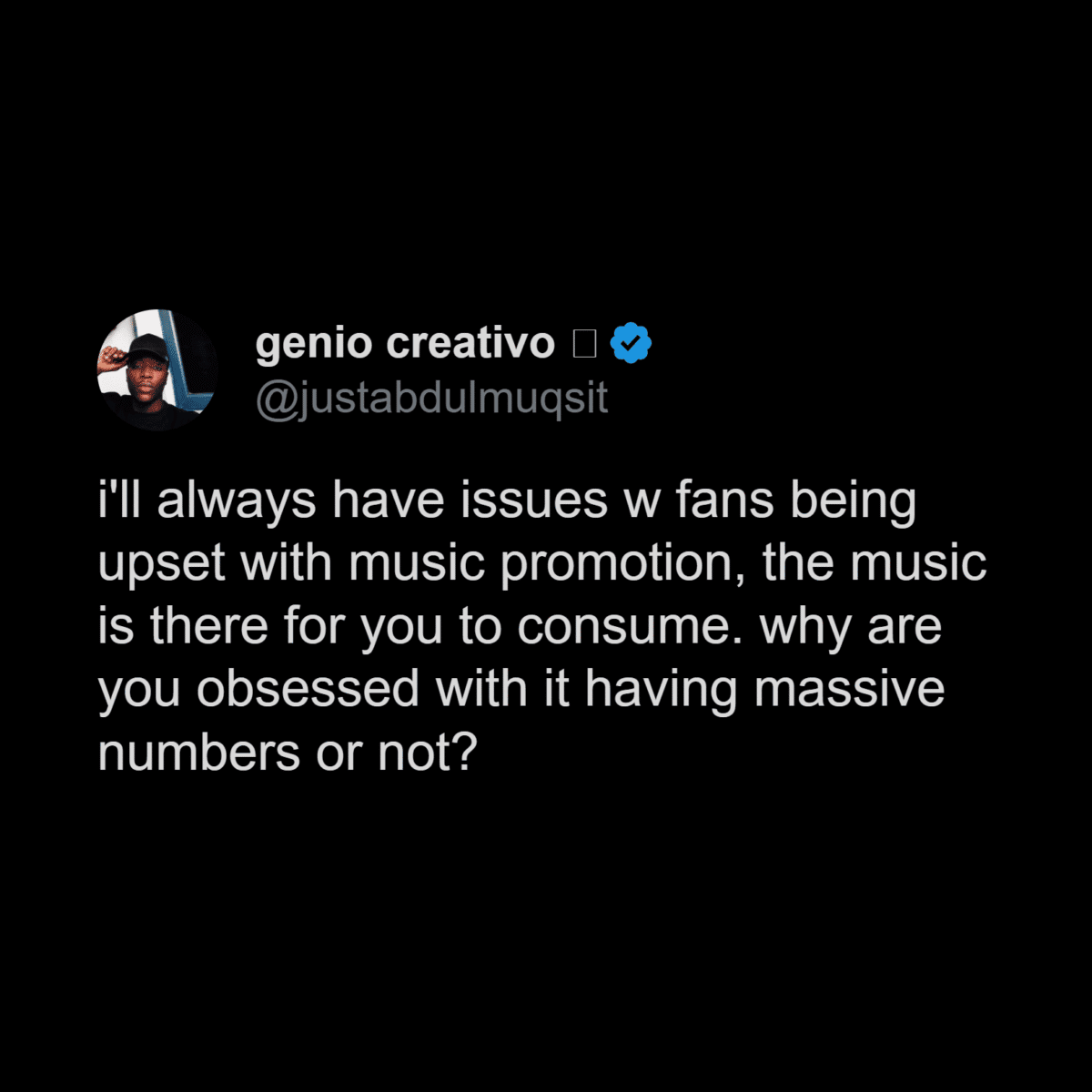
I put out a tweet recently, and the reactions have been interesting. What struck me most was how quickly a conversation about music consumption became a conversation about numbers, competition and the perceived responsibility of an artist’s team. I think that reaction says a lot about where fandom is today.
 There is nothing inherently wrong with wanting your favourite artist to succeed. Fans have always played an important role in the growth of artists. They listen, share, recommend, attend shows, buy records and create communities around the music they love.But somewhere along the way, fandom evolved into something much more competitive. For many people, being a fan is no longer simply about enjoying an artist’s music. It has become about proving that your artist is bigger, better and more successful than somebody else’s. Streams. Charts. Debuts. Certifications. Monthly listeners. Playlist placements. The music increasingly feels like the starting point for a competition rather than the reason for it. And that is where I have a problem. I find it strange that a song can be genuinely loved by someone, yet their enjoyment of that song somehow becomes dependent on how many other people are listening to it. If I love a record, what does its first-week number have to do with my experience of it? If an album doesn’t debut at number one, does that suddenly make the songs worse? If another artist gets a bigger hit, does that somehow diminish what my favourite artist created? Obviously not. But stan culture has created a system where commercial performance is increasingly treated as artistic validation. A song is not simply good. It is “doing numbers.” An album is not simply great. It is “outperforming.” And when those numbers don’t meet expectations, somebody must be responsible. Usually, the label, then the management, then the marketing team.
You can see this in some of the recent reactions from Ayra Starr’s fanbase around the promotion of her music. There is absolutely a legitimate conversation to have about how an artist is marketed. Fans can question rollout strategies, promotional decisions and whether a label is doing enough to support an artist. But there is a line between criticism and harassment. When people begin aggressively calling out members of an artist’s team because a song isn’t performing at the level they believe it should, I think we’ve moved beyond fandom.And I think the deeper motivation deserves scrutiny. Because I’m not convinced that all of this anger is actually about the music. A significant part of it seems rooted in competition. An Artist cannot simply be an Artist. He/She has to be bigger than her counterparts. Your song cannot simply be successful. It has to outperform somebody else’s. The album cannot simply be enjoyed. It has to prove something. The fan begins treating the artist’s commercial performance as a personal battle. Your favourite artist succeeds, and you feel like you have won. Your favourite artist underperforms, and you feel like you have lost. Another artist gets a bigger debut, and suddenly there is something to complain about, you’re competing with the music instead of consuming it. Whatever happened to simply being a fan that hears a song they love, play it, recommend it, go to concerts and enjoy the work. That used to be enough. I’m not arguing that promotion doesn’t matter. It obviously does. Artists and their teams have a responsibility to market their work effectively. But fans don’t have to carry that responsibility on their backs, there is a difference between supporting an artist and believing you own the outcome of their career.
I conducted a small survey around this subject matter, asking listeners whether promotion should matter so much, whether numbers influence how they perceive music, and whether a great song should be enough on its own and the responses offered an interesting perspective.
Chineme Chine, A Writer, believes fans’ demands for promotion come from a mixture of care, frustration and competitiveness. She argues that in an oversaturated music landscape, visibility matters because even great music can go unnoticed. For her, quality and promotion work together: quality sustains attention, but visibility creates the opportunity for that attention in the first place. She also admits that numbers can influence discovery. When exploring an unfamiliar artist, strong-performing songs can serve as an entry point before she digs deeper into the artist’s catalogue. However, once she already knows and loves an artist, their numbers have little impact on how he perceives their music.
Abayomi Ridwan, a print production artist, takes a more critical view. He argues that fans often demand numbers less because they genuinely care about promotion and more because they need statistics to compete with rival fanbases. Charts and streams have become ammunition for stan wars, allowing fans to prove that their favourite artist is bigger or better than their perceived “OPPs.”
Both responses ultimately reveal the tension at the centre of modern fandom: promotion matters, but the obsession with numbers can distort why we listen to music in the first place. There is nothing wrong with wanting great music to reach more people. But there is a difference between wanting visibility for an artist you love and needing their numbers to validate that love. Ultimately, we seem to have made charts and streaming figures become more important than the music itself and we have slowly shifted from consuming music to competing through it. Promotion matters, numbers matter, and artists deserve effective teams behind their work, but none of these should replace the personal relationship between an artist and their audience. You should be able to love a song without needing it to win a chart battle, and support an artist without turning their performance into a personal victory or defeat. At its core, music should still be about the music. Everything else should come second.