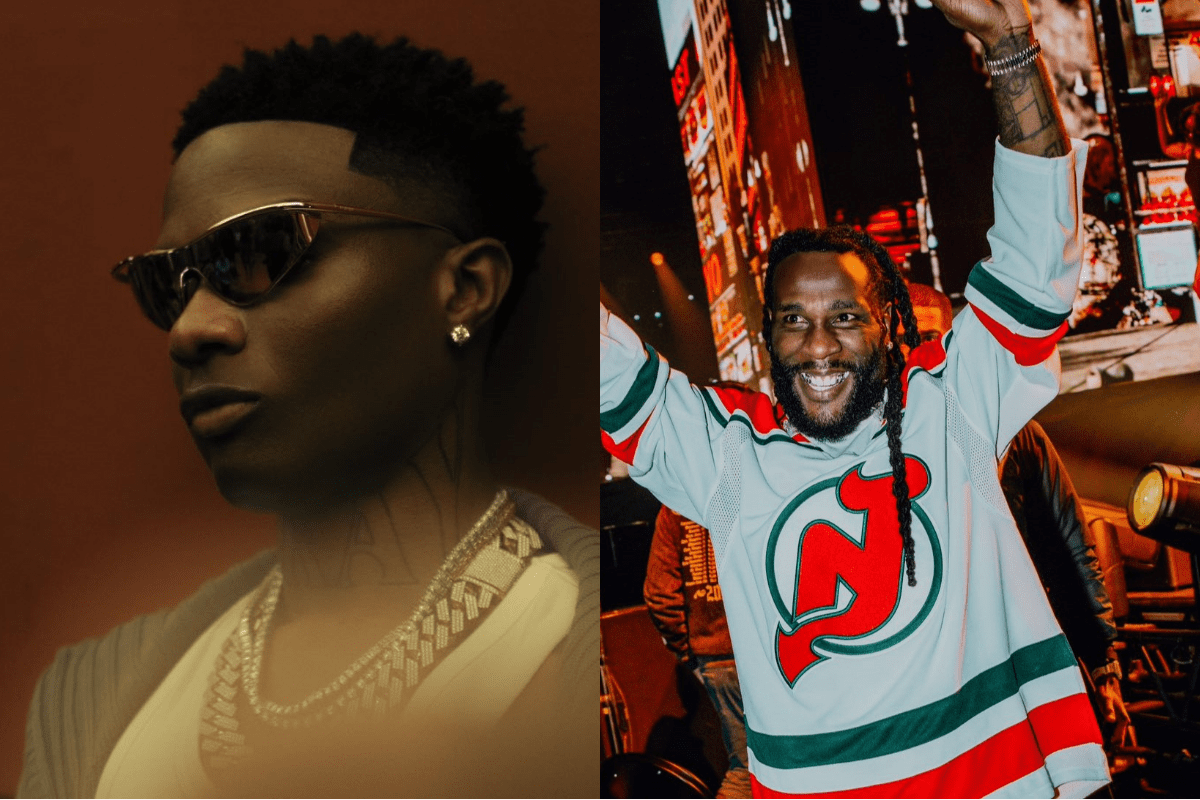
In recent weeks, the Nigerian music landscape has been electrified by rising tensions between two of its biggest stars: Burna Boy and Wizkid. What many fans see as a sudden escalation is, in fact, a culmination of years of simmering rivalry, one that has long played out on social media, stoked by fan armies like Wizkid FC and the Outsiders. But beneath the noise is a more layered story about rivalry, industry culture, and the fragile relationship between artists and the media that document them.
We spoke with Emmanuel Waziri Okoro of Afrocritik and Belema Iyo, host of Afrobeats To The World Podcast, to unpack what this moment represents.
For Okoro, the current tension is not new—it is both escalation and continuation. He situates it within a rivalry that has “been simmering for years,” one that has largely played out online, amplified by fan communities like Wizkid FC and Outsiders. What makes this moment different, however, is not just visibility but intensity. The shift from digital sparring to something more physical signals a breakdown in how competitive tension is managed at the highest level of the industry. This is particularly striking when placed against their history. These are not distant rivals; they have collaborated—on records like “Ginger” and “Ballon d’Or.” That history complicates the narrative. It suggests that what is unfolding is not simply opposition, but unresolved friction that has periodically been masked by moments of alignment. For Okoro, the concern is not just the incident itself, but what it models. When two of Nigeria’s biggest cultural exports—artists who have commanded global stages—cannot navigate rivalry without escalation, it risks normalising that behaviour for a generation watching closely. On impact, his position is deliberately nuanced. There is no denying that controversy fuels attention; afrobeats, as a global conversation, thrives on visibility. But attention is not neutral. The deeper issue, he argues, is cultural transmission. What does it mean for younger artists, with far less power and protection, to internalise conflict as part of the playbook? In an industry still developing its institutional safeguards, that normalisation can have consequences that extend far beyond headlines.
Belema approaches the same moment from a more introspective angle. For her, the escalation speaks to something deeply cultural: a tendency to avoid confrontation until it becomes unavoidable. “We worry about image and perception too much,” she argues, pointing to a broader Nigerian disposition where difficult conversations are deferred in favour of maintaining appearances. In that context, what looks like sudden conflict is often the release of long-unaddressed tension. Rather than focusing on the spectacle or its audience, she centres the individuals involved. This, in her view, is ultimately a private matter that should be resolved between the parties, regardless of public opinion. The fixation on perception—how it looks, how it plays internationally can become a distraction from the more important question: whether issues are actually being addressed at their root.
Where both perspectives converge, interestingly, is on the question of media—but from different angles. Okoro’s critique is structural. He argues that Nigerian media is routinely sidelined during the moments that matter most: album rollouts, major announcements, defining interviews. In those moments, international platforms are prioritised, while local outlets are treated as secondary. That imbalance shapes capacity. When controversy emerges, the expectation that the same under-resourced, often overlooked local media should suddenly lead accountability efforts becomes difficult to sustain. Accountability, in this sense, cannot be divorced from access and relationship-building. Belema, on the other hand, locates the challenge within the practice of media itself. She points to the role of personal relationships—how proximity to artists can soften critique—and to a tendency to prioritise opinion over fact. Her position is clear: the media’s responsibility is not to act as judge or enforcer, but to report accurately and consistently. “Report the facts,” she insists, placing the burden of accountability on the public rather than the press.
Taken together, these views outline a tension within Nigerian music media. On one hand, structural exclusion limits authority; on the other, internal choices shape credibility. Between both lies the unresolved question of what accountability should actually look like in an ecosystem where access, influence, and independence are constantly negotiated.
What this moment ultimately reveals is not just a conflict between two artists, but a set of pressures within afrobeats itself: the weight of global visibility, the persistence of local cultural habits, and the evolving role of media within that intersection. If afrobeats is to continue its ascent, these are the conversations that must move beyond the timeline—into something more deliberate, more honest, and ultimately more sustainable.